 By Ayse Ayhan
Endometriosis After Menopause
 By Ayse Ayhan
Endometriosis, traditionally considered a disease of reproductive-age women, expected to regress after menopause. However, a growing body of evidence challenges this assumption, showing that the disease can persist—or even arise de novo—in peri-menopausal and post-menopausal women. In a narrative review…
Key Points Lay Summary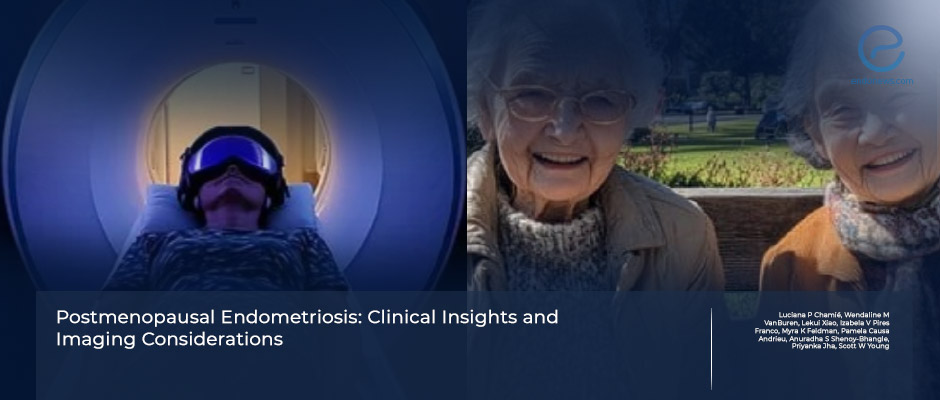
 By Selma Oransay
Imaging findings in postmenopausal endometriosis
 By Selma Oransay
Most women diagnosed with endometriosis during their reproductive years become asymptomatic in postmenopausal period, but lesions remain biologically active despite lower estrogen levels. The pathophysiology of postmenopausal endometriosis remains unclear, though lesions appear less active and extensive. The risk of…
Key Points Lay Summary
Diagnosis and the Treatment of Postmenopausal Endometriosis
By Selma Oransay
About 190 million women around the world are diagnosed with endometriosis. The majority of the cases are between 30 and 40 years of age. After menopause, the incidence of endometriosis declines to 2-5%, and it is more common in women…
Key Points Lay Summary
Menopause-management strategies for women with endometriosis.
By Selma Oransay
Menopausal hormonal therapy is the most effective treatment for menopausal symptoms, such as hot flushes, sweating, sleep disturbances, mood changes, and joint pain. Approximately 75% of all women experienced some degree of these symptoms, while 2-4% were diagnosed with endometriosis. Menopausal…
Key Points Lay Summary
 By Bahar Yuksel
Novel Diagnostic Strategies for the Detection of Malignant Transformation of Endometriosis
 By Bahar Yuksel
Endometriotic implants can grow on various organs and tissues in the pelvis, leading to pain, infertility, and other symptoms. Most cases of endometriosis are benign and there is a small risk of malignant transformation. The review conducted by Dr. Hiroshi…
Key Points Lay Summary
The Epithelial–Mesenchymal Transition and IVF success
By Bahar Yuksel
Endometriosis is a disease with lots of unknowns and one is that the reason for causing infertility. It is possible that a decrease in mitochondrial content may diminish oocyte quality in endometriosis. Furthermore, endometriosis alters the microenvironment of maturing oocytes that…
Key Points Lay Summary
The effect of hormone therapy after surgical menopause on endometriosis recurrence
By Selma Oransay
Definitive surgery for severe and advanced endometriosis is hysterectomy with bilateral oophorectomy, which may cause vasomotor symptoms, sleep deprivation, mood change, and dyspareunia in the patients. Furthermore, after the surgical removal of the ovaries, the sudden drop in estrogens causes…
Key Points Lay Summary
What happens to women with endometriosis after menopause?
By Selma Oransay
Endometriosis affects women in their reproductive period of life, with expected regression of lesions in the postmenopausal period. Literature about postmenopausal endometriosis assessing the prevalence, pathogenesis, and treatment is limited. As 2-5 % of postmenopausal women are affected by this uncommon condition, developing stress…
Key Points Lay Summary
 By Nasuhi Engin Aydin
Epigenetic link between endometriosis and cancer
 By Nasuhi Engin Aydin
Although endometriosis is considered a benign condition the cellular, histologic, and molecular data strongly demonstrate that endometriosis has neoplastic characteristics. There is strong evidence that endometriosis shares striking features with malignancy like normal tissue dissemination, invasion, and organ damage, as well as new vessel formation (neoangiogenesis). In…
Key Points Lay Summary
 By Irem Onur
A clearer picture of "endometriosis after menopause"
 By Irem Onur
Delfin Avendano Tan and Marie Josephine Guanlao Almeria are obstetrician-gynecologists from the Philippines. They recently published a review article titled "Postmenopausal endometriosis: drawing a clearer picture". In this paper, the authors discussed the pathogenesis, risk factors, and management of postmenopausal…
Key Points Lay Summary