Rethinking Ground Truth in Endometriosis "AI"
May 15, 2026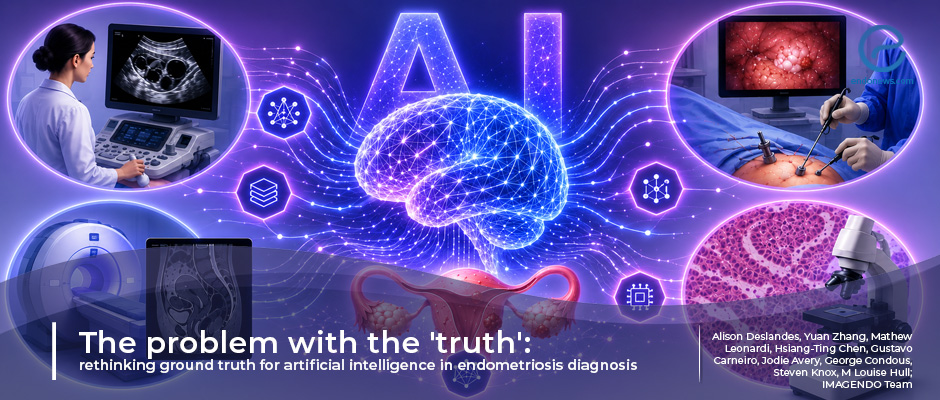
artificial intelligence, endometriosis, ultrasound, surgery, machine learning, pathology, diagnosis, non-invasive, preoperative
Key Points
Highlights:
- Artificial intelligence (AI) development in preoperative imaging based detection of endometriosis is challenged by the absence of a universally reliable non-invasive diagnostic “ground truth.”
- The authors propose multimodal, uncertainty-aware, and AI-compatible diagnostic frameworks for future endometriosis AI systems.
Importance:
- This commentary addresses a fundamental but often overlooked issue in AI-driven endometriosis diagnostics: how to define reliable reference standards when all currently available diagnostic modalities have intrinsic limitations and biases.
What's Done Here?
- Researchers from the IMAGENDO collaborative group critically evaluated the strengths and limitations of imaging, surgery, and histopathology as potential “ground truths” for AI model development in endometriosis diagnosis.
- The authors reviewed challenges including selection bias, noisy labeling, interobserver variability, and inconsistencies across diagnostic modalities.
- Several future-oriented approaches were proposed, including multimodal consensus models, uncertainty-aware labeling systems, longitudinal outcome-based validation, and standardized AI-compatible reporting frameworks.
Key Results:
- Imaging, surgery, and histopathology all demonstrated important limitations as standalone reference standards for AI training.
- Imaging accuracy remains highly operator-dependent and still has limited sensitivity for superficial endometriosis.
- Surgical diagnosis is influenced by selection bias, surgeon expertise, lesion visibility, and variability in reporting systems.
- Histopathological confirmation may be limited by sampling issues, tissue destruction, and interpretative variability.
- The authors highlighted “noisy labeling” as a major challenge in AI development, where inaccurate or inconsistent human labels may propagate diagnostic errors into AI systems.\
- Proposed solutions included multimodal diagnostic integration, probabilistic/uncertainty-aware labels, and consensus-based AI learning approaches.
- The commentary emphasized that future AI systems should reflect the complexity and uncertainty inherent in endometriosis diagnosis rather than forcing binary diagnostic classifications.
Strengths and Limitations:
- Strengths are the multidisciplinary integration of imaging, surgery, pathology, reproductive medicine, and artificial intelligence expertise, together with a balanced conceptual analysis of diagnostic uncertainty in endometriosis.
- Limitations are that the article is a conceptual commentary rather than an original validation study, and the proposed AI-ground-truth frameworks remain theoretical and require prospective clinical implementation and testing.
From the Editor-in-Chief – EndoNews
"Artificial intelligence is rapidly transforming modern medicine, particularly in fields where diagnosis remains difficult, delayed, or highly operator-dependent. Endometriosis represents one of the clearest examples of this challenge. Imaging-assisted AI systems have the potential to expand diagnostic access, improve consistency, and enhance preoperative detection, especially in environments where expert-level imaging interpretation is limited.
However, the reliability of any AI model is inherently dependent on the quality and validity of the reference data from which it learns.Particularly in imaging-assisted preoperative detection, AI holds considerable promise for improving diagnostic accessibility, standardization, and potentially reducing longstanding diagnostic delays.
This commentary addresses a central but often underappreciated issue in AI-assisted endometriosis research: defining an appropriate reference standard for model training and validation. In practice, imaging findings, surgical observations, and histopathological confirmation each provide valuable yet incomplete representations of disease. Importantly, the article does not diminish the role of surgical-pathological confirmation as the definitive tissue-based diagnosis of endometriosis. Rather, it highlights that when these modalities are translated into computational training datasets, intrinsic limitations—including operator dependency, lesion heterogeneity, sampling variability, selection bias, and inconsistencies in interpretation—become critically important.
One of the strongest aspects of this work is its recognition that clinically meaningful AI cannot be developed simply through larger datasets or more sophisticated algorithms alone. If training labels themselves contain uncertainty or inconsistency, these limitations may be propagated into the AI systems being developed. The discussion surrounding noisy labeling, multimodal integration, uncertainty-aware learning, and probabilistic diagnostic frameworks reflects a sophisticated understanding that endometriosis detection is not always binary and may require AI systems capable of handling diagnostic ambiguity rather than eliminating it artificially.
The commentary also raises a broader conceptual point: future AI-assisted approaches may influence not only diagnostic workflows, but also how endometriosis itself is categorized and understood. As imaging technologies, computational modeling, and integrated phenotypic analyses continue to evolve, disease classification may increasingly shift toward multidimensional and probability-based frameworks rather than rigid categorical definitions. Whether these advances ultimately improve long-term patient outcomes remains to be established, but this article addresses one of the most fundamental methodological questions in AI-assisted medicine—how to define reliable and clinically meaningful truths from which intelligent systems learn."
Lay Summary
Artificial intelligence (AI) is increasingly being explored as a tool to improve the diagnosis of endometriosis, a disease that remains difficult to identify accurately and often requires years before confirmation.
However, a new commentary published in Human Reproduction by Alison Deslandes and collegues including IMAGENDO Team argues that one of the greatest challenges in developing AI systems for endometriosis is deciding what should actually be considered the “truth” used to train these technologies.
Traditionally, surgical visualization with histopathological confirmation has been regarded as the definitive tissue-based diagnosis of endometriosis. However, the authors emphasize that when surgery, imaging, or histopathology are used as reference standards for AI model training, each modality introduces important limitations and biases. Imaging-based detection remains highly operator-dependent and may miss superficial lesions, while surgical findings can vary according to lesion visibility, surgical expertise, and reporting practices. Histopathological confirmation may also be influenced by sampling limitations and tissue-processing artifacts.
The commentary additionally highlights the problem of “noisy labels,” where inconsistencies in human interpretation may unintentionally become incorporated into AI systems during model training. To address this issue, the authors propose future approaches based on multimodal integration, uncertainty-aware probability models, consensus-driven labeling systems, and standardized AI-compatible reporting frameworks.
Rather than viewing endometriosis detection as a simple binary process, the authors suggest that future AI systems may need to reflect the complexity, variability, and uncertainty inherent in real-world clinical practice. The article highlights that while AI has significant potential to improve non-invasive preoperative detection and reduce diagnostic delay, careful definition of reference standards will remain essential for the development of clinically meaningful and trustworthy AI-assisted tools.
Research Source: https://pubmed.ncbi.nlm.nih.gov/41739996/
artificial intelligence endometriosis ultrasound surgery machine learning pathology diagnosis non-invasive preoperative
