Can Pelvic Floor–Focused Exercise Help Endometriosis Pain?
Jan 15, 2026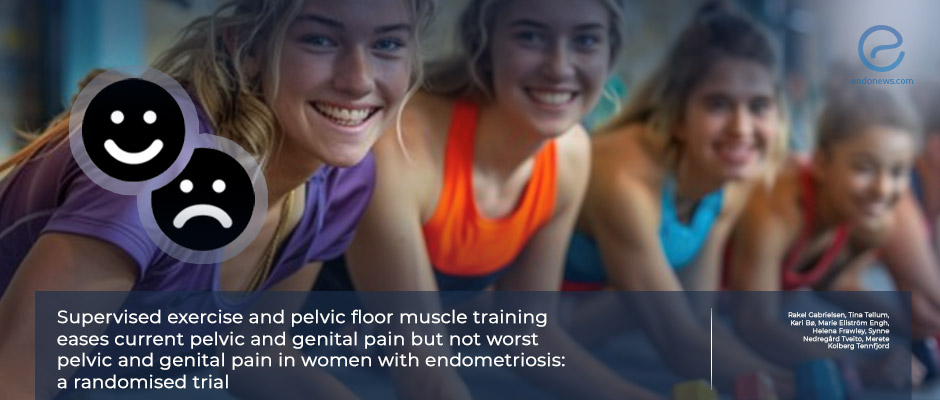
Multimodal care with supervised exercise may show some benefit for current pelvic pain.
Key Points
Highlights:
- Exercise interventions did not reduce worst pelvic or genital pain in women with endometriosis.
- However, both supervised group exercise and independent individual exercise improved current pelvic or genital pain, with benefits sustained for up to 12 months.
Importance:
- Structured exercise may serve as a useful adjunctive strategy for managing ongoing pelvic pain in endometriosis, even if it does not alleviate peak pain symptoms.
What’s done here:
- Researchers conducted a two-arm, parallel-group randomized controlled trial with concealed allocation and intention-to-treat analysis.
- Eighty-one women with endometriosis were randomized to supervised group exercise or independent individual exercise, and outcomes were assessed with partial blinding.
- The primary aim was to evaluate the effect of exercise on pelvic and genital pain, with follow-up extending to 12 months.
Key results:
- Supervised group exercises or independent individual exercises did not have an effect on worst pelvic or genital pain, like dyspareunia, dysuria, quality of life, chronic constipation, and pelvic floor muscle function.
- These exercises improved current pelvic or genital pain.
- This improvement persisted for up to one year.
Limitations:
- Participants had high baseline motivation and physical activity levels, which may limit generalizability.
- The study was not powered to detect differences in secondary outcomes.
- Exposure to exercise interventions may have influenced behavior in the control context.
- Measures of dyspareunia did not capture pain intensity or duration and were not fully validated.
- Few participants had severe endometriosis, and findings at 12 months should be interpreted cautiously.
From the Editor-in-Chief – EndoNews
"Exercise is frequently recommended as part of non-pharmacologic care for chronic pain, yet its role in endometriosis-associated pelvic pain remains incompletely defined. This randomized controlled trial offers an important contribution by carefully distinguishing between worst pain intensity and current, day-to-day pain, two outcomes that are often conflated in clinical discussions but reflect different dimensions of patient experience.
The study demonstrates that adding supervised or independent exercise—including pelvic floor muscle training—to multidisciplinary pain management does not reduce peak pelvic or genital pain. However, the observed and sustained improvement in current pain is clinically meaningful. For many patients, it is this ongoing pain burden that interferes with daily functioning, work, and psychological wellbeing. By targeting this aspect of pain, exercise may support symptom management even when it does not modify severe pain flares.
Methodologically, the trial is strengthened by its randomized design, long follow-up, and integration within a multidisciplinary pain framework. At the same time, several factors temper interpretation. Participants were already physically active and motivated, limiting generalizability, and the study was not powered to detect changes in several secondary outcomes. Importantly, the absence of improvement in worst pain underscores that exercise should not be framed as a stand-alone or curative intervention.
This work reinforces a broader shift in endometriosis care: moving away from single-modality solutions toward multidimensional symptom management. Exercise should be viewed as one component of supportive care—valuable for improving everyday pain and physical engagement, but insufficient alone for addressing the full complexity of endometriosis-associated pain.
For clinicians, the message is nuanced but clear. Exercise may be recommended with realistic expectations, emphasizing functional improvement rather than pain elimination. For patients, the findings validate that lack of response in severe pain does not reflect failure or inadequate effort. Instead, they highlight the need for individualized, multimodal strategies that respect the heterogeneous nature of endometriosis pain."
Lay Summary
Supervised group exercise or independent individual exercise, including pelvic floor muscle training added to multidisciplinary pain management, did not reduce worst pelvic or genital pain in women with endometriosis, according to a new study published in the Journal of Physiotherapy. However, the interventions were associated with improvements in current pelvic or genital pain.
“Effects on other outcomes warrant further investigation,” the authors noted.
To examine the impact of exercise on symptoms such as dyspareunia, dysuria, quality of life (including psychological distress and symptoms of depression and anxiety), chronic constipation, and pelvic floor muscle function, a research team led by Dr. Merete Kolberg Tennfjord from the Department of Health and Exercise at Kristiania University College, Oslo, conducted a two-arm, parallel-group randomized controlled trial.
The study included 81 women aged 18 to 45 years with laparoscopically confirmed endometriosis and pelvic or genital pain. All participants first attended a multidisciplinary pain management course. They were then randomized to either a supervised exercise program or no additional exercise.
Forty-one women completed weekly supervised general exercise sessions including pelvic floor muscle training for four months, combined with home-based training two to three times per week. The remaining 40 women did not receive additional exercise training beyond standard care.
The results showed that the exercise intervention did not reduce worst pelvic or genital pain, nor did it significantly affect secondary outcomes. In contrast, current pelvic or genital pain improved, and this benefit appeared to be maintained at 12-month follow-up.
Overall, the findings suggest that structured exercise may help reduce day-to-day pain burden in endometriosis, even if it does not alleviate peak pain episodes.
The authors caution that conclusions regarding other outcomes remain inconclusive.
Research Source: https://pubmed.ncbi.nlm.nih.gov/41006088/
exercise pelvic pain genital pain dyspareunia dysuria pelvic floor

