Can We Predict Surgical Pain Outcomes?
May 22, 2026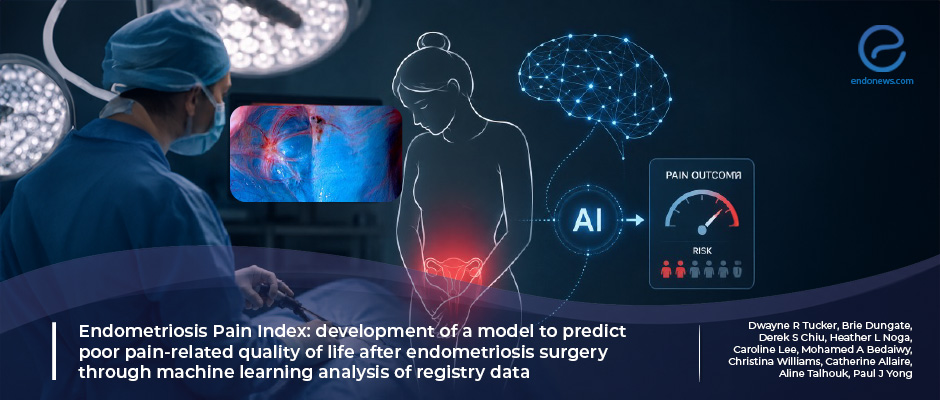
Why do some patients continue to suffer after endometriosis surgery? Machine learning offers new clues
Key Points
Highlights:
- A machine learning–based “Endometriosis Pain Index” predicted poor pain-related quality of life after surgery with moderate but stable performance.
- Key predictors included baseline pain burden, psychological distress, pain catastrophizing, pelvic floor myalgia, abdominal wall pain, and smoking status.
- The accompanying editorial emphasizes that persistent postoperative pain reflects multidimensional biopsychosocial mechanisms beyond visible lesion burden alone.
Importance:
- Persistent pain after endometriosis surgery remains a major clinical challenge despite technically successful procedures.
- These studies support a shift from lesion-centric thinking toward multidimensional pain phenotyping and personalized surgical counselling.
- The authors highlight the future need for external validation and integration of molecular, sensory, and neurobiological biomarkers into predictive models.
What's Done Here?
- This is a prospective registry data analysis from 650 individuals undergoing endometriosis surgery at a tertiary referral center between 2013 and 2020.
- Patients completed standardized multidimensional pain phenotyping before surgery, including psychological, pain, and quality-of-life assessments.
- Thirty-two preoperative candidate predictors were evaluated using multiple machine learning approaches, including elastic net regression, random forest, and neural network models.
- The primary outcome was poor pain-related quality of life 1–2 years after surgery, measured using the Endometriosis Health Profile-30 (EHP-30) pain subscale.
- The editorial by Pogatzki-Zahn et al. critically evaluates the strengths and limitations of predictive pain modeling in endometriosis surgery and discusses future directions including omics, sensory phenotyping, and biomarker integration.
Key results:
- The highest and most stable predictive accuracy for poor postoperative pain-related quality of life was achieved by the random forest model.
- Poor postoperative pain-related quality of life was observed in 16% of patients and was strongly associated with baseline pain burden, anxiety, depression, pain catastrophizing, pelvic floor myalgia, abdominal wall pain, smoking status, and back pain.
- The accompanying commentary emphasized that current prediction models remain limited by reliance on patient-reported outcomes and highlighted the future need for external validation and integration of molecular, inflammatory, sensory, and neurobiological biomarkers.
Strengths and Limitations:
- Strengths are the large prospective cohort, multidimensional preoperative pain phenotyping, and independent validation of multiple machine learning models.
- Limitations are the single-center design, moderate predictive performance, lack of external validation, and absence of molecular or neurobiological biomarkers in the prediction models.
From the Editor-in-Chief – EndoNews
"The paper we summarized in EndoNews for you this week, together with its accompanying commentary, highlights an important conceptual transition in endometriosis care: the movement from lesion-centered surgical thinking toward multidimensional pain-centered medicine. While surgery remains a cornerstone of treatment, these findings reinforce that persistent postoperative pain cannot be fully explained by anatomical disease burden alone. Instead, pain outcomes appear to emerge from a complex interplay between peripheral pathology, central sensitization, psychological distress, myofascial dysfunction, and broader biopsychosocial mechanisms.
Importantly, the proposed “Endometriosis Pain Index” should not be interpreted as a definitive surgical decision tool, but rather as an early framework for individualized risk stratification. Its moderate predictive performance underscores both the promise and the current limitations of machine learning approaches in chronic pain medicine. The strong contribution of factors such as pain catastrophizing, anxiety, depression, pelvic floor myalgia, and abdominal wall pain further supports the evolving understanding that endometriosis-associated pain frequently extends beyond visible pelvic lesions.
Perhaps the most valuable contribution of these papers is not the algorithm itself, but the broader message they deliver: successful future management of endometriosis will likely depend on integrating surgical, neurobiological, inflammatory, sensory, and psychosocial dimensions into a unified precision-medicine framework. In this context, the next generation of predictive models may require incorporation of molecular biomarkers, sensory phenotyping, and cognitive pain-processing measures to better capture the heterogeneity of endometriosis-associated pain."
