Rethinking Nonsteroidal Anti-Inflammatory Drugs in Endometriosis
May 8, 2026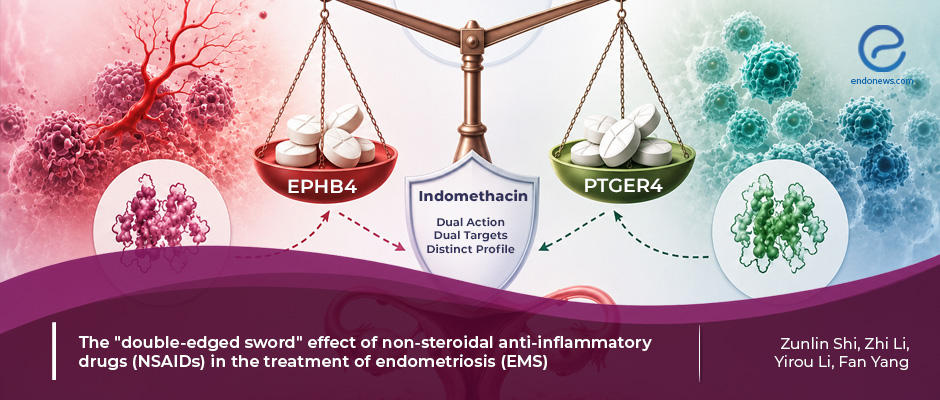
Common NSAIDs may exert heterogeneous and potentially paradoxical effects in endometriosis
Key Points
Highlights:
- Commonly used nonsteroidal anti-inflammatory drugs (NSAIDs) may exert heterogeneous effects in endometriosis beyond pain control.
- EPHB4 emerged as a potential risk-associated signaling hub linked to angiogenesis and disease progression.
- Indomethacin demonstrated a distinct dual-target profile involving both EPHB4 and PTGER4 pathways.
Importance:
- This study challenges the traditional assumption that all NSAIDs exert uniformly beneficial effects in endometriosis and proposes a target-oriented framework for precision medication.
What's Done Here:
- Researchers integrated network toxicology, Mendelian randomization, functional enrichment analysis, and molecular docking to investigate the long-term molecular effects of nine commonly used NSAIDs in endometriosis.
- Drug-target interactions were analyzed using multiple predictive databases, while causal associations with endometriosis risk were evaluated using large-scale genetic datasets.
- Molecular docking simulations were performed to validate interactions between NSAIDs and core signaling targets.
Key Results:
- A total of 463 overlapping targets between NSAIDs and endometriosis-associated genes were identified.
- EPHB4 was consistently identified as a central hub gene potentially mediating risk-associated effects of multiple NSAIDs.
- Functional analyses linked EPHB4 signaling to angiogenesis, cell migration, and ephrin receptor pathways relevant to lesion progression.
- Indomethacin uniquely demonstrated a dual-regulatory profile by targeting both the protective PTGER4 pathway and the potentially risk-associated EPHB4 pathway.
- Mendelian randomization and colocalization analyses provided supportive genetic evidence for causal associations involving EPHB4 and PTGER4.
Strengths and Limitations:
- Strengths are the integration of network toxicology, Mendelian randomization, functional enrichment analysis, and molecular docking within a multi-layered computational framework, together with large-scale genetic datasets and extensive sensitivity analyses.
- Limitations are the absence of experimental biological validation, reliance on computational and genetic inference models, restriction to European-ancestry datasets, and the inability to directly establish clinical causality regarding NSAID use and endometriosis progression.
From the Editor-in-Chief – EndoNews
"NSAIDs have long occupied a paradoxical position in endometriosis management: they are among the most frequently used therapies for symptom relief, yet surprisingly little is known about their potential influence on the pathological processes underlying lesion progression. This study attempts to move beyond symptom control and addresses a clinically relevant but insufficiently explored question — whether different NSAIDs may exert heterogeneous effects on pathways involved in angiogenesis, inflammation, and lesion behavior.
Lay Summary
Nonsteroidal anti-inflammatory drugs (NSAIDs) are among the most commonly used medications for relieving pain associated with endometriosis.
However, whether long-term NSAID use influences the disease process itself has remained unclear.
A new study published in Reproductive Biology and Endocrinology by Fan Yang and colleagues from China suggests that different NSAIDs may exert distinct and potentially paradoxical effects on pathways involved in endometriosis progression.
Using network toxicology, Mendelian randomization, functional enrichment analysis, and molecular docking simulations, the investigators analyzed nine commonly used NSAIDs, including ibuprofen, naproxen, diclofenac, celecoxib, and indomethacin.
By integrating drug-target prediction databases with large-scale genetic datasets, the researchers identified EPHB4 as a potential central signaling hub associated with angiogenesis and lesion progression in endometriosis.
The study suggested that several NSAIDs may theoretically interact with pathways linked to disease progression, raising the possibility that these drugs could have heterogeneous biological effects beyond pain relief.
In contrast, indomethacin demonstrated a distinct dual-target profile involving both the potentially protective PTGER4 pathway and the risk-associated EPHB4 pathway. Molecular docking simulations further supported stable interactions between multiple NSAIDs and these signaling targets.
Although the findings are based on computational, genetic, and structural biology analyses rather than direct clinical evidence, the study proposes a new framework suggesting that NSAIDs may not exert identical effects in endometriosis. The authors suggest that future management strategies could potentially move toward more mechanism-based and individualized selection of anti-inflammatory therapies.
Research Source: https://pubmed.ncbi.nlm.nih.gov/41353125/
pain Drug safety; Endometriosis; Mendelian randomization; Molecular docking; NSAIDs; Network toxicology
