
Why Will my Pain Not Go Away?
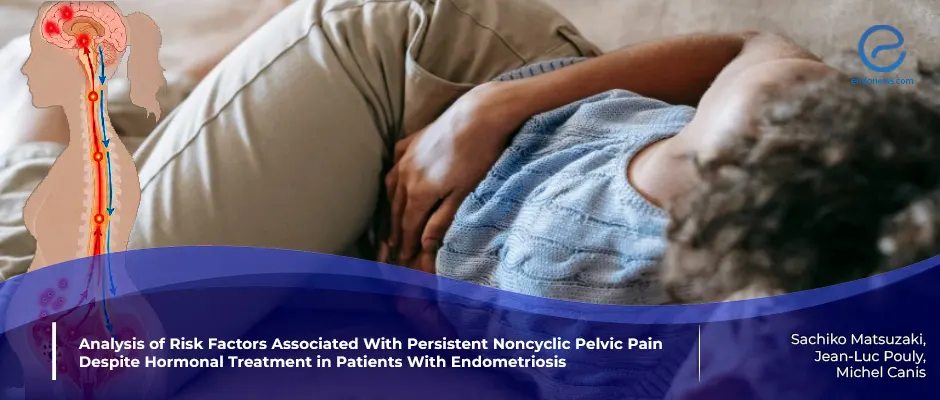
Study Identifies Clinical Factors Associated With Persistent Endometriosis Pain Despite Hormonal Treatment
Key Points
Highlights:
- Persistent pelvic pain, despite hormonal treatment was common in this surgical endometriosis cohort.
- Persistent symptoms may warrant assessment of pain mechanisms beyond lesion-directed treatment alone.
Importance:
- Hormonal treatment does not adequately control pain in all women with endometriosis.
- Recognizing clinical features associated with persistent pain may help identify patients who need earlier individualized and multidisciplinary pain management.
What’s done here:
- This is a retrospective analysis of prospectively collected clinical data from 164 women with histologically confirmed deep endometriosis and/or ovarian endometrioma at a French tertiary referral center.
- All women received at least 3 months of hormonal treatment before surgery.
- Pre-treatment symptoms and clinical characteristics were analyzed to identify factors associated with persistent noncyclic pelvic pain during hormonal treatment.
Key Results:
- 41% (67/164) of women had persistent noncyclic pelvic pain despite hormonal treatment.
- Ovarian endometrioma, was associated with approximately 4-fold higher odds of persistent pain (OR 4.11).
- Pre-treatment noncyclic pelvic pain showed the strongest association, with approximately 7- to 12-fold higher odds, depending on baseline pain severity.
- Severe dyspareunia was associated with approximately 7-fold higher odds of persistent pain (OR 6.73).
- Previous cesarean section was also associated with persistent pain (OR 9.53), although this finding was based on only nine women with prior cesarean delivery and should be interpreted cautiously.
- Deep infiltrating endometriosis itself was not independently associated with persistent pain after multivariable adjustment.
Strengths and Limitations:
- Strengths: Histologically confirmed endometriosis, detailed face-to-face pain assessment, and evaluation of multiple clinical factors using multivariable analysis.
- Limitations: Single-center retrospective analysis of a selected surgical referral population, modest sample size, recalled pre-treatment pain scores, and no systematic assessment of adenomyosis or nociceptive, neuropathic, and nociplastic pain mechanisms.
Editorial Perspective
From the Editor-in-Chief – EndoNews"Persistent pain during hormonal treatment should not automatically be interpreted as persistent endometriotic activity or failure of hormonal suppression. This distinction is clinically important because endometriosis-associated pain may evolve beyond predominantly nociceptive input from lesions to include neuropathic and nociplastic mechanisms, with considerable overlap between pain phenotypes.
An intriguing finding is that deep endometriosis itself was not independently associated with persistent pain after adjustment for other clinical factors; this information reinforces the broader principle that anatomical disease and pain severity do not necessarily parallel one another. Persistent symptoms therefore should not, by themselves, be assumed to indicate a need for more hormonal suppression or additional surgery. Careful reassessment of the pain phenotype and potential contributors to chronic pelvic pain may be more informative.
These findings should nevertheless be interpreted cautiously. This was a relatively small, retrospective analysis of a selected tertiary-care surgical population, without systematic assessment of adenomyosis or differentiation of nociceptive, neuropathic, and nociplastic pain.
The association with previous cesarean delivery is particularly hypothesis-generating given the very small number of women with this history.
The important direction for future research is therefore not simply to identify who has persistent pain, but to determine why pain persists in each patient. Prospective studies incorporating standardized pain phenotyping alongside detailed characterization of endometriosis may help move treatment from lesion-centered escalation toward genuinely personalized, multimodal and multidisciplinary pain management."
Lay Summary
Women with ovarian endometrioma, chronic noncyclic pelvic pain, severe painful intercourse, or a history of cesarean delivery may be more likely to experience persistent pelvic pain despite hormonal treatment, according to a new study.
Researchers led by Dr. Michel Canis at CHU Clermont-Ferrand and Université Clermont Auvergne in France investigated clinical factors associated with persistent pain during hormonal treatment in women with endometriosis.
The study included 164 women with histologically confirmed deep endometriosis and/or ovarian endometrioma. Clinical and pain-related information was collected through face-to-face interviews before surgery. All participants had received at least three months of treatment with progestins, combined oral contraceptives, or gonadotropin-releasing hormone agonists.
Despite hormonal treatment, 41% of the women continued to experience noncyclic pelvic pain. Multivariable analysis identified ovarian endometrioma, pre-treatment noncyclic pelvic pain, severe dyspareunia, and previous cesarean delivery as factors associated with persistent pain. deep infiltrating endometriosis itself was not independently associated with persistent pain after adjustment for other clinical factors.
The findings highlight that persistent endometriosis-associated pain may involve more than disease location or hormonal responsiveness alone. The authors emphasize the importance of distinguishing nociceptive, neuropathic, and nociplastic pain mechanisms, as different pain phenotypes may require different therapeutic approaches. For some women with persistent symptoms, individualized management incorporating medical, surgical, and multidisciplinary strategies may therefore be appropriate.
The authors caution that the findings require confirmation in prospective studies and that the study was conducted in a tertiary surgical referral population, which may limit their generalizability.
The study was published in Reproductive Medicine and Biology.
Research source: https://pubmed.ncbi.nlm.nih.gov/41221030/
PubMed: 41221030
DISCLAIMER
EndoNews highlights the latest peer-reviewed scientific research and medical literature that focuses on endometriosis. We are unbiased in our summaries of recently-published endometriosis research. EndoNews does not provide medical advice or opinions on the best form of treatment. We highly stress the importance of not using EndoNews as a substitute for seeking an experienced physician.