
Peritoneal Adhesions in Endometriosis
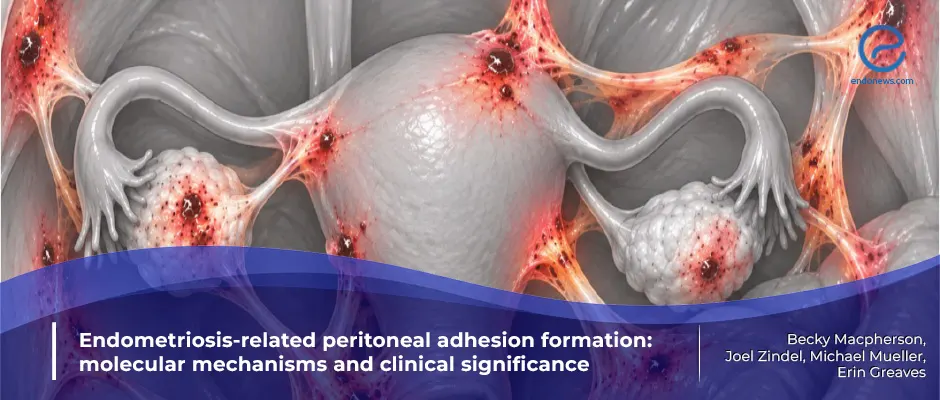
Beyond Surgical Scarring: Understanding Adhesion Formation in Endometriosis
Key Points
Highlights:
- Peritoneal adhesions contribute to pain, infertility, distorted anatomy, and surgical complexity in endometriosis.
- Their formation may reflect dysregulated peritoneal repair within a chronically altered inflammatory and fibrotic microenvironment, even without previous surgery.
Importance:
- Understanding why adhesions develop in endometriosis is important because current prevention strategies primarily target postoperative adhesion formation, while effective pharmacological approaches to prevent or treat disease-associated adhesions remain an unmet need.
What's Done Here?
- This is a narrative review of 124 studies examining physiological peritoneal healing, mechanisms of pathological adhesion formation, how the endometriosis-associated peritoneal environment may modify these processes, and current and potential strategies for adhesion prevention and treatment.
- PubMed, Embase, and Cochrane Library were searched for literature published between January 2000 and February 2026.
- Randomized controlled trials, observational studies, systematic reviews, and relevant experimental studies were included, with experimental models used where human mechanistic data were limited.
Outlines:
- Normal peritoneal healing requires a tightly regulated balance between inflammation, coagulation, fibrin deposition, fibrinolysis, extracellular matrix remodeling, and mesothelial repair.
- Failure of these processes to resolve appropriately can result in persistent fibrin scaffolds, myofibroblast activation, collagen deposition, and mature adhesions.
- In endometriosis, chronic inflammation, altered immune regulation, oxidative stress, hormonal signaling, impaired fibrinolysis, repeated tissue injury, and exposure to blood and iron may collectively shift the peritoneal environment toward pathological repair and fibrosis.
- Adhesions can be present before any previous surgery; reports cited in the review indicate that 50–70% of women with moderate-to-severe endometriosis may have adhesions at their first operation, supporting a contribution from the disease-associated peritoneal environment itself.
- However, it remains uncertain which mechanisms are specifically driven by endometriosis rather than representing general pathways of pathological peritoneal repair. Much of the mechanistic evidence comes from experimental models, and direct human evidence remains limited.
Strengths and Limitations:
- Strengths are: The review integrates clinical and experimental evidence across peritoneal wound healing, inflammation, coagulation and fibrinolysis, fibrosis, and endometriosis biology, while also critically considering potential preventive and therapeutic strategies.
- Limitations are: This is a narrative rather than systematic review or meta-analysis, and much of the proposed endometriosis-specific biology is derived from animal or experimental models, with limited direct human evidence and no established pharmacological therapy for preventing or treating endometriosis-related adhesions.
Editorial Perspective
From the Editor-in-Chief – EndoNews"Adhesions in endometriosis are often considered either a marker of advanced disease or an undesirable consequence of surgery. This review invites a broader biological perspective: adhesion formation itself to be part of the endometriosis-associated peritoneal response.
The observation that adhesions are frequently present at first surgery is particularly important, because it separates at least part of adhesiogenesis from previous operative injury and raises the question of what makes the endometriotic peritoneum susceptible to pathological repair.
The distinction between normal healing and persistent repair is central. In physiological wound healing, inflammation, coagulation, fibrin deposition, fibrinolysis, and tissue remodeling are coordinated and ultimately resolve. Endometriosis introduces a very different biological setting—recurrent tissue injury, chronic inflammation, altered immune activity, oxidative stress, hormonal influences, and fibrosis. Rather than requiring a completely unique adhesion pathway, these factors may modify conserved wound-healing mechanisms so that a normally transient reparative response becomes prolonged or repeatedly reactivated.
This concept also raises an intriguing question about the relationship between the lesion and its surrounding peritoneum. Endometriosis should not necessarily be viewed as an isolated focus surrounded by biologically normal tissue. If lesional activity can influence fibrinolysis, immune responses, mesothelial behavior, and fibroblast activation beyond the lesion itself, adhesions and fibrosis may represent components of a wider local tissue response. Whether endometriotic tissue initiates this process, becomes incorporated into an already developing adhesion, or both, however, remains unresolved.
Considerable caution is needed before translating this mechanistic framework into clinical practice. Much of the evidence for macrophage behavior, mesothelial transformation, fibrinolytic dysfunction, and other proposed pathways comes from experimental models. Human endometriosis develops over years within a hormonally active and repeatedly challenged peritoneal environment that cannot be fully reproduced by experimentally induced disease in animals. The review appropriately highlights this translational gap.
The clinical challenge is therefore larger than preventing adhesions after an operation. Surgical technique and adhesion barriers address an important iatrogenic component, but they cannot fully address a biological environment that may already favor adhesiogenesis before surgery. At present, there is no established pharmacological treatment capable of preventing or reversing endometriosis-related adhesions.
A particularly important future direction will be to determine which mechanisms demonstrated experimentally are actually active in human endometriosis, in which patients, and at what stage of adhesion development. Distinguishing disease-driven adhesiogenesis from postoperative repair may ultimately allow prevention to move beyond mechanical separation of injured surfaces toward biologically targeted intervention.
Understanding adhesions as an active component of the peritoneal disease environment, rather than simply as scar tissue left behind by disease or surgery, may substantially change how this important aspect of endometriosis is investigated."
Lay Summary
Adhesions are bands of scar-like tissue that can bind pelvic organs to one another and alter their normal anatomy. They are commonly encountered in women with endometriosis and may contribute to pain, infertility, bowel problems, and difficulties during subsequent surgery.
Importantly, adhesions can already be present at a woman’s first operation for endometriosis, indicating that surgery itself is not their only possible trigger.
In a review published in Human Reproduction Update, Macpherson and colleagues from the University of Warwick, ETH Zurich, and the University of Bern, examined what is currently known about how these adhesions develop and how they might be prevented or treated. The authors brought together evidence from 124 clinical and experimental studies published primarily between 2000 and February 2026.
Normally, when the peritoneum—the thin membrane lining the abdominal and pelvic cavity—is injured, the body temporarily deposits fibrin to support healing and then removes it as repair progresses. If this balance is disturbed, fibrin can persist, providing a scaffold on which cells and collagen accumulate and eventually form permanent adhesions.
The authors propose that endometriosis may make this normal healing process more likely to go off course: Repeated tissue injury, inflammation, immune alterations, oxidative stress, hormonal signaling, and exposure to blood and iron may together maintain an environment in which healing does not fully resolve and fibrosis persists.
However, an important gap remains: much of this biological explanation comes from laboratory and animal models rather than direct studies in women with endometriosis. It is therefore still unclear which mechanisms are unique to endometriosis and which represent general responses of the peritoneum to injury.
Current approaches largely aim to reduce adhesions caused by surgery rather than preventing adhesions generated by the disease itself. No effective medication is currently available specifically to prevent or treat endometriosis-related adhesions. Understanding why the peritoneum becomes prone to pathological healing may therefore open an important new direction for developing treatments that address adhesions as part of endometriosis biology rather than only as a surgical complication.
Research source: https://pubmed.ncbi.nlm.nih.gov/42600047/
PubMed: 42600047
DISCLAIMER
EndoNews highlights the latest peer-reviewed scientific research and medical literature that focuses on endometriosis. We are unbiased in our summaries of recently-published endometriosis research. EndoNews does not provide medical advice or opinions on the best form of treatment. We highly stress the importance of not using EndoNews as a substitute for seeking an experienced physician.