
Immune Evasion in Endometriosis
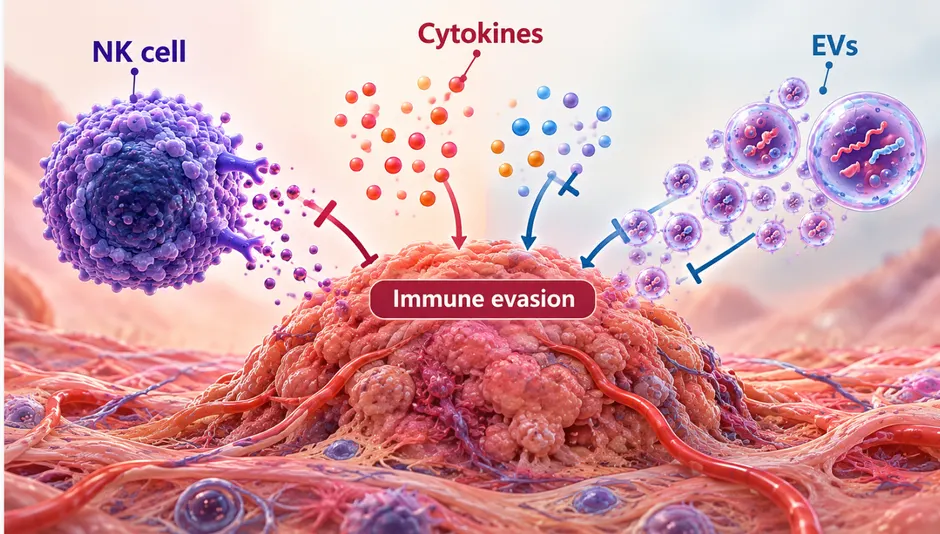
How NK Cells, Cytokines, and Extracellular Vesicles Shape Immune Evasion in Endometriosis
Key Points
Highlights:
Impaired immune surveillance may contribute to the persistence of endometriotic lesions.
NK-cell dysfunction, cytokine imbalance, and extracellular vesicles (EVs) may act together to promote immune evasion.
Importance:
Understanding immune evasion in endometriosis may reveal new therapeutic targets for preventing lesion persistence and progression.
What's Done Here?
This is a narrative review of published studies examining immune dysfunction in endometriosis.
The review focuses on NK-cell activity, cytokine signaling, and extracellular vesicles/exosomes.
Their interactions in immune evasion and lesion persistence are critically discussed.
Outlines:
NK-cell dysfunction: Reduced cytotoxic activity and altered activating/inhibitory receptor signaling may impair clearance of ectopic endometrial tissue.
Immune regulation: Increased regulatory NK-cell subsets and reduced NKG2D signaling may contribute to immune tolerance.
Cytokine imbalance: Proinflammatory cytokines, including IL-1β, IL-6, IL-8, IL-17, and TNF-α, may promote inflammation, proliferation, and angiogenesis.
Immunosuppressive cytokines: TGF-β1 and IL-10 may suppress NK-cell activity and support lesion persistence and fibrosis.
Extracellular vesicles: Lesion-derived EVs may impair NK-cell cytotoxicity through NKG2D-related signaling and promote apoptosis of activated immune cells.
Integrated mechanism: These interacting pathways may establish a local microenvironment that favors immune evasion and lesion survival.
Therapeutic implications: NK-cell receptors, cytokine pathways, and EV-mediated signaling represent potential targets requiring further investigation.
Strengths and Limitations:
Strengths are the integration of NK-cell biology, cytokine networks, and extracellular vesicle signaling into a comprehensive framework of immune dysfunction in endometriosis.
Limitations are the narrative design, heterogeneous underlying studies, and lack of systematic evidence grading or clinical validation of the proposed therapeutic targets.
Editorial Perspective
From the Editor-in-Chief – EndoNewsThis review brings attention to a critical but incompletely understood aspect of endometriosis: the mechanisms that allow ectopic lesions to persist despite immune surveillance. The proposed interactions among impaired NK-cell cytotoxicity, dysregulated cytokine networks, and extracellular vesicle signaling provide a biologically plausible framework for immune evasion. However, much of the evidence remains heterogeneous, and the relative contributions of these mechanisms to disease initiation, progression, and recurrence require further validation. Their therapeutic potential is promising but remains investigational.
Importantly, immune dysfunction should be considered within the broader inflammatory, hormonal, and neuroimmune complexity of endometriosis, rather than as an isolated explanation for its pathogenesis. Bridging these molecular insights with clinical manifestations, pain mechanisms, and personalized, multimodal, multidisciplinary management is an important research priority.
This perspective is particularly timely for the Endometriosis Foundation of America (EndoFound) 2027 Medical Conference, Immuno-Neuro Endometriosis and Bioelectronic Medicine in Neuropelveology, scheduled for March 4–6, 2027, in New York City. With Dr. Tamer Seckin among its program directors, the conference will bring together basic scientists, clinicians, and surgeons to explore the translation of neuroimmune discoveries into improved diagnosis and treatment.
Lay Summary
In a review published in Frontiers in Immunology, Dr. Ulrika Ottander and colleagues from Umeå University, Sweden, examined how immune dysfunction may contribute to the development and persistence of endometriosis.
The authors focused on natural killer (NK) cells, which normally help eliminate abnormal cells, inflammatory and regulatory cytokines, and extracellular vesicles that carry signals between cells.
The review describes how reduced immune-cell activity, altered cytokine signaling, and extracellular vesicles released by endometriotic lesions may work together to prevent immune clearance.
These mechanisms may also promote inflammation, blood vessel formation, and lesion growth.
The findings provide a framework for understanding immune evasion in endometriosis and identifying potential therapeutic targets.
However, further research is needed before these mechanisms can be translated into effective treatments.
Research source: https://pubmed.ncbi.nlm.nih.gov/42614378/
PubMed: 42614378
DISCLAIMER
EndoNews highlights the latest peer-reviewed scientific research and medical literature that focuses on endometriosis. We are unbiased in our summaries of recently-published endometriosis research. EndoNews does not provide medical advice or opinions on the best form of treatment. We highly stress the importance of not using EndoNews as a substitute for seeking an experienced physician.