
Endometriosis and Vascular Dysfunction
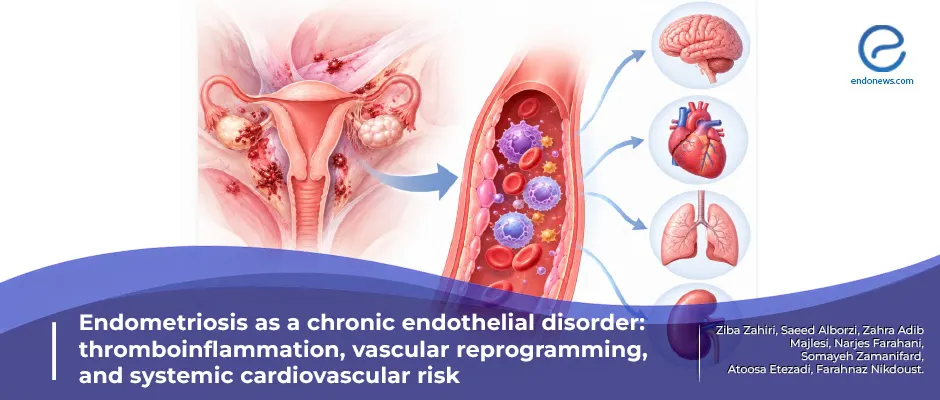
From Pelvic Lesions to Vascular Risk: Rethinking Endometriosis Through the Endothelium
Key Points
- Endometriosis may have vascular consequences extending beyond the pelvis, with epidemiologic studies reporting increased cardiovascular risk.
- Endothelial dysfunction and thromboinflammation are proposed as potential links between local endometriosis-associated inflammation and systemic vascular alterations.
Importance:
- Understanding the vascular effects associated with endometriosis may help identify patients at increased long-term cardiovascular risk and move care beyond reproductive and pain-related outcomes alone.
What's Done Here?
- This review integrates epidemiologic, vascular, inflammatory, and experimental evidence to examine how endothelial activation, platelet hyperreactivity, immune responses, coagulation, and impaired fibrinolysis may contribute to microvascular dysfunction in endometriosis.
- It also explores imaging and circulating biomarkers, potential mechanism-directed therapies, and strategies for biomarker-guided clinical trials.
Outlines:
- Chronic inflammation, oxidative stress, hormonal signaling, and abnormal angiogenesis may alter endothelial function and vascular homeostasis in endometriosis.
- Thromboinflammation is proposed as a central mechanism linking endothelial activation with platelets, innate immune responses, coagulation, and fibrinolysis.
- Combining advanced vascular imaging with circulating and multi-omic biomarkers could potentially identify biologically distinct vascular endotypes and enable more individualized risk assessment.
- Proposed therapeutic directions include targeting thromboinflammation, platelet/coagulation pathways, endothelial dysfunction, and related metabolic or oxidative mechanisms; these approaches remain largely translational rather than established treatments for endometriosis.
Strengths and Limitations:
- Strengths are: the review brings vascular biology, immunology, coagulation, imaging, and biomarker research into an integrated framework and provides a roadmap for testing vascular mechanisms in endometriosis.
- Limitations are: direct mechanistic evidence in women with endometriosis remains limited, and several proposed pathways are derived partly from other inflammatory and thromboinflammatory diseases; causal links, validated vascular biomarkers, and effective mechanism-directed treatments therefore remain to be established.
Editorial Perspective
From the Editor-in-Chief – EndoNews"The association between endometriosis and cardiovascular disease is increasingly supported by epidemiologic evidence. However, the mechanisms connecting local endometriotic lesions with systemic vascular dysfunction remain uncertain. This review proposes endothelial activation and thromboinflammation as potential biological links.
From a pathological perspective, endometriosis involves more than ectopic endometrial glands and stroma. Its microenvironment includes inflammatory cells, vascular remodeling, fibrosis, and complex interactions between immune, endothelial, and neural components. These processes may contribute to both local disease activity and systemic alterations, although their causal relationships remain incompletely understood.
This broader perspective is particularly relevant to the emerging concept of immuno-neuro-endometriosis, which recognizes the interactions between immune responses, neural signaling, and tissue pathology. Dr. Tamer Seckin and the Endometriosis Foundation of America have placed this concept at the center of their upcoming 2027 Medical Conference, “Immuno-Neuro Endometriosis: Bioelectronic Medicine in Neuropelveology.”
The meeting will explore neuroimmune mechanisms, neuromodulation, and their potential implications for disease biology and treatment.
The vascular mechanisms discussed in this review may represent another component of this interconnected biological environment. Endothelial cells, immune cells, platelets, and neural pathways participate in overlapping inflammatory and tissue-remodeling processes. However, biological interactions demonstrated within lesions cannot automatically be extrapolated to systemic cardiovascular disease.
The priority is therefore to establish whether vascular abnormalities are directly related to endometriosis, reflect shared risk factors, or arise through independent mechanisms. This will require well-characterized patient populations, lesion-level pathological assessment, validated vascular biomarkers, and longitudinal clinical studies.
The future of endometriosis research lies in integrating its immune, neural, and vascular dimensions without assuming that their biological connections have already been established. Such integration may ultimately provide a more precise understanding of disease heterogeneity and its consequences beyond the pelvis."
Lay Summary
Endometriosis is increasingly associated with health effects beyond the reproductive system, including a higher risk of cardiovascular disease. In a review published in International Immunopathology, led by Dr.Etezadi and Dr. Nikdoust from Iran, examine whether changes in the small blood vessels and their endothelial lining could help explain this association.
The authors propose that persistent inflammation, oxidative stress, abnormal blood-vessel formation, platelet activation, and immune responses may disturb normal vascular function.
Particular attention is given to thromboinflammation, in which inflammation and blood-clotting pathways reinforce one another.
The review also considers whether vascular imaging combined with blood-based and molecular biomarkers could eventually identify patients with different patterns of vascular involvement and guide more individualized care.
However, many of these mechanisms and proposed treatments remain experimental, and direct evidence in women with endometriosis is still limited.
Research source: https://pubmed.ncbi.nlm.nih.gov/42378824/
PubMed: 42378824
DISCLAIMER
EndoNews highlights the latest peer-reviewed scientific research and medical literature that focuses on endometriosis. We are unbiased in our summaries of recently-published endometriosis research. EndoNews does not provide medical advice or opinions on the best form of treatment. We highly stress the importance of not using EndoNews as a substitute for seeking an experienced physician.